Core theme that sets apart KAILASA’s economy is putting people first, ahead of profits and material wealth. This principle derives naturally from the focus on dharma and moksha.
“People are wealth, people are life, people are energy. Finally, people are God! Give everything to people. People bring everything you need. Whether it is basic things like food or things like love, joy, laughter everything people bring in your life. To enrich people, your involvement with people shows your involvement with life .” – HDH Sri Nithyananda Paramashivam
In Paramashiva’s economy in KAILASASM, the people and Paramashiva are co-creators of money, where our ability to be intelligently active and constantly contributing is true wealth. The ability to keep the currency current and moving gives value to the currency.
According to Hindu economics, human goals or Purusharthas are four fold: artha (prosperity or wealth), kaama (pleasures), dharma (cosmic law) and moksha (liberation from the cycle of life and death). Thus, the traditional idea of wealth is only one part of the economic principles.
Two of the most important aspects that drive Hindu economy are:
Dharma – which can be interpreted as flowing with the cosmic law. Part of dharma is ethics. Hindu economic practices cannot be separated from ethics.
Moksha – realizing our true reality, that we are consciousness, we are in the space of “Oneness” or Advaita. Realizing this state and space of Oneness is described as enlightenment. Functioning in this world while in this space of enlightenment is called “Living Enlightenment” by His Divine Holiness.
Such a society using Advaita as a strategy for success is an “Enlightenment-based ecosystem”, and the economy is an enlightenment based (consciousness-based) economy. According to Paramashiva, all enlightenment-based ecosystems share certain behavioural patterns.
For the nation of KAILASASM, many applications of these economic principles are primarily from the Agamas authored by Paramashiva, the original author of the science of yoga and enlightenment. The Agamas can be considered applied science based on the principles in the Vedas and the Upanishads – which is Advaita. Ishavasya Upanishad says in its very first verse “Consciousness pervades everything”.
While this may imply that consciousness is the primary reality, and the objects it manifests as are secondary reality, the Veda-Agamas does not imply that the material world should not be taken into account – only that the ultimate reality (paramarthika satya) cannot be ignored and has to be taken into consideration. Which is why Paramashiva discusses wealth and economics in the Agamas. He sees wealth as a core expression of enlightenment, and details a framework to create a superconscious society through an Agamic economy.
Even sanyaas (monkhood), which means renunciation, means only renouncing one’s personal ties, but involves embracing and taking responsibility for the entire world [1].
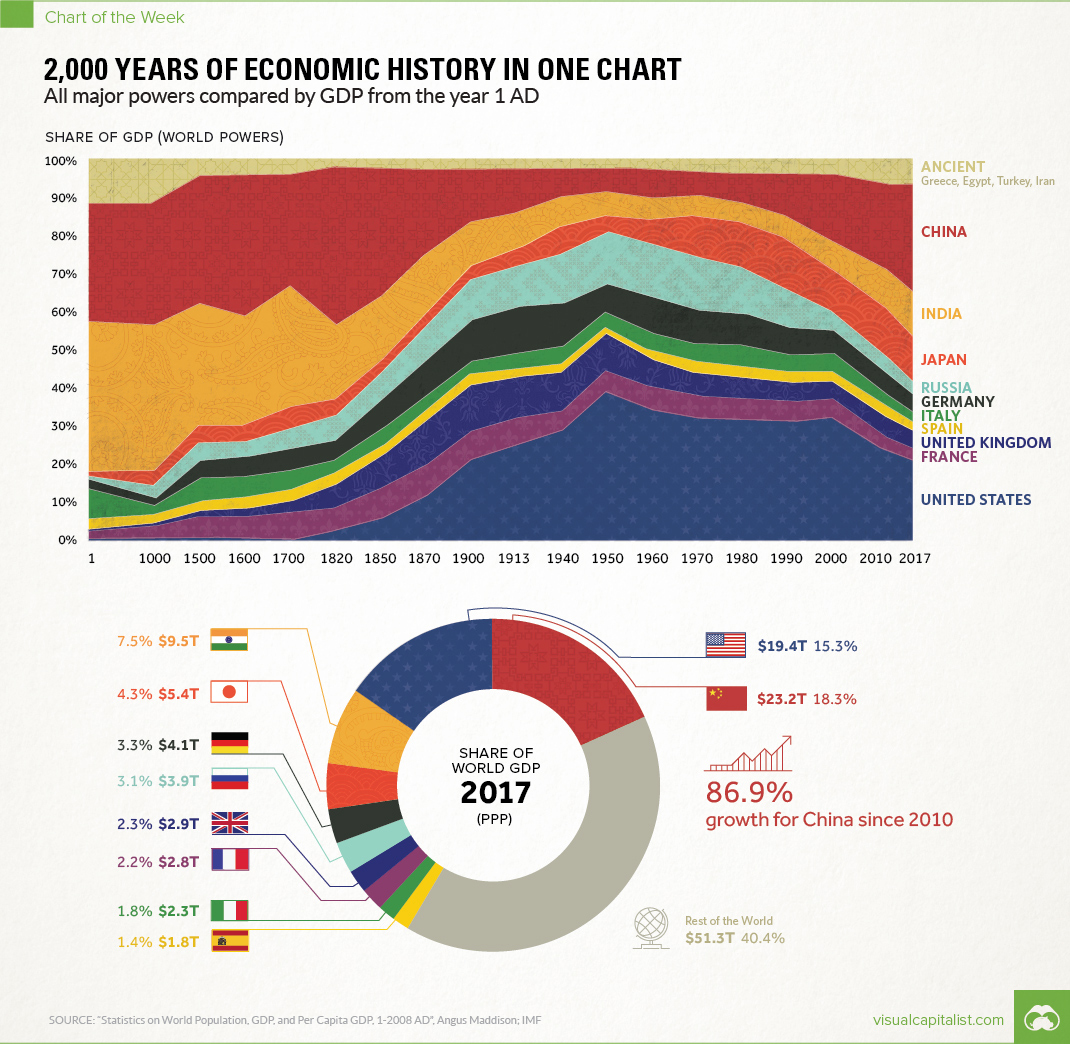
In the 1980s the Organization for Economic Cooperation and Development (OECD) commissioned a study under a famous economic historian Angus Maddison. His monumental research has shown that between years 1 and 1700 AD, India’s Hindu economy accounted for a quarter to one-third of the total world GDP, but began to decline sharply under foreign rule till in the 1950s their share of world GDP came down to 3 percent.
Pew Research on religious groups and Wall Street Journal reports that Hindus are the best educated religious group in the U.S – 77% of American Hindus have a college degree, compared with an average of 27% for all U.S. adults. Hindus are the highest earning community in the US and highest tax paying community in many countries around the world.
Hindu economic principles – which promote abundance in both the inner and outer worlds and have been proven to create wealthy communities for many millennia – continue to be relevant in the modern world, thus disproving the limited views of economist and socialists such as Weber, Schweitzer and Kapp.
Many core principles of a Hindu economy are outlined as early as in the Rig Veda (X.117.4) and various Upanishads. Subsequently, there were several sources of economic ideas in Hindu texts: Kautilya’s Arthashastra (320 BC), Shura-Neetisaara, Dharmashaastras and other manuscripts penned by Apastambha, Vasistha, Yaajnavalkya and others [1], addressed sophisticated economic principles such as labor theory, supply-demand principles, and scarcity theory of value, among others.
Core principles of the world’s greatest Hindu nation
“Let us understand Paramashiva’s concept of currency, wealth and economy: I am defining wealth as per Sadashiva from Agamas. Your ability to intelligently enrich the society in some form – enriching does not mean only through teaching, it can even be stitching their shoes. Even that is enriching; enriching in some form. Enriching humanity in some form and doing it very intelligently and inspiring humanity to contribute back to you, so you can continue to enrich – that is “wealth”. That is wealth consciousness. That’s the strategy for wealth.
Currency is modus operandi. The methodology through which interaction and transactions happen, is currency. If the wealth consciousness is awakened in multiple people and you make the currency more current, that is called economy. Understand I have defined these three words – wealth, currency and economy. End of the day just if your existence makes money you will not be bothered about money. Your very consciousness will live wealthy.
The economy Sadashiva is teaching is neither capitalism or communism nor socialism – it is Responsibilism. The responsibility you take that decides the kind of wealth that is going to be around you.”
~His Divine Holiness Sri Nithyananda Paramashivam, 5th Nov 2017, Bengaluru, India

Recent Comments